
My “Other Life”: Music & Dance!
Dance has been a big part of my life since I was in my teens. As a young 19-year old I was working a minimum-wage job in NYC. I had temporarity dropped out of college and was living in Manhattan. I would eventually return and graduate Magna Cum Laude in Bioloogy from City College in NYC and go on to earn my Ph.D in Sensory Neuroscience from Syracuse University. But prior to that evolution, I was seriously planning a professional career in dance.
One afternoon in 1967, I walked into the Henry Street Settlement Playhouse at 263 Henry Street where the Alwin Nikolais Dance Theatre was based and declared to the woman seated at the front desk, simply, “I want to dance!” Alwin Nikolais was a world-renowned dancer, choreographer, composer, teacher and the director of an internationally famous dance company. So my declaration was fairly bold, to put is mildly.
The woman behind the desk looked at me and said, much to my surprise, “Well, Mr Hamer, as it happens we are recruiting young male dancers. So if you are willing to work 15 hours per week at the front desk or wherever you are needed, we can offer you a full scholarship.” I could not believe my ears! No audition!?
Then she added, “You’ll start in the beginning-intermediate class so that we can evaluate your dance level and needs…Then you will be able take as many classes are you can handle each day, within your skill level of course. Is that acceptable to you?”
“Yes! Yes! Of course!” Then I peppered her with questions: “When can I start? What time do classes start each day? What do I need to buy? Dance shoes, dance leggings, other things?…and so on…” She said that I could start the following Monday and “just wear dance tights and bring a couple of towels and a water bottle and a lock for my locker and….”
My head was spinning with amazement and joy! And so began an amazing apprenticeship in Nikolais-Style Modern dance. The classes were exhiliarating and physically gruelling. Each class began with a warm-up on the floor, stretching, strenghening exercises, all performed with rigorous timing. The stretching was especially challenging given my novice status and tight muscles and tendons. After our “warm-up” floor exercises, we began bar-work and then open floor work. By the time the floor warm-up was done, I was in a literal puddle of sweat.
The Genius of Alwin Nikolais
We did ballet-like bar-work, but then we verged into improvisational work either dancing alone or in a group. The Nikolais method emphasized awareness of space, ours our fellow dancers’, and even the space implied by our dance gestures, beyond our body limits. It was thrilling. To Nikolais, dance was form-in-motion. He was not interested in programmatic choreography – story telling, as in many clasical Ballets. He choreographed many of the major dance pieces, and designed the costumes and lighting and staging. And he composed the electronic music for these pieces.
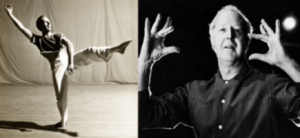
LEFT: A young Alwin Nikolais as a young modern dancer. RIGHT: Mature Nikolais, as I knew him in the late 1960s.
Here are some sample images from Nikolais’ choreographies. I encourage you to check out some of their performances on Youtube. They were unique, remarkable. In fact, I have only been to one dance performance in my life where the audience interrupted a piece before it was finished to give a standing ovation: and that was at a performance by the Alwin Nikolais Dance Company in Seattle WA around 1980! Moreover, that evening the audience was so “jazzed”, so in love with what we had winessed, that we wouldn’t leave the theatre and forced the Nikolais Dance Company to do an encore….unheard of!

<><><>
Afro-Cuban Dance: Rueda de Casino
Jumping ahead about quarter century, well into my career as a Visual Neuroscientist at Smith-Kettlewell, I was attending an international conference of the Association for Research in Vision & Ophthalmology (ARVO) in Fort Luaderdale, FL. One evening some colleagues and I went out Casino dancing (Cubans call “Salsa” dance “Casino”) at the Club Mystique in the Miami Airport Hilton, the place to go on Thursdays. I was dancing with a lovely Cuban woman, a close friend of a friend of mine in the SF Bay area. She was a professionl dancer and choreographer and so I was a bit intimidated. Suddenly the center of the packed dance floor opened up and a wild excitement rippled through the dance crowd. A group of 16 dancers, 8 couples, were dancing in a circle – the song was “Lloraras!” sung by the Venezuelan Bassist-Band Leader Oscar D’Leon. The dance was RUEDA DE CASINO, a Cuban group dance that originated in Cuba in the 1950s. The dancers knew all the lyrics to the song and were singing along as they danced, exchanging partners rapidly with complex dance patterns I’d never seen before, leaders sometimes crossing the Rueda circle to dance with another woman, all moving together, on cue, each move called (yelled!) by the apparent leader: a super-fast Rueda had just busted out. It was hot. It was fast. It was exciting. I wanted to learn it! That was it – I was hooked!
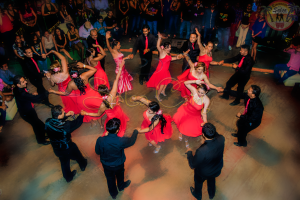
A Rueda perfromance in Venezuela
Upon returning to the SF Bay Area, I saw Rueda once again at the SF Carnaval parade. My friends and I begged the leaders of the Rueda dancers – Tomas Montero and David Lenneman , based in LA – to teach us. So we flew them up from LA to do intensive weekend workshops in our homes, and my dancer-friends and I flew to LA for workshops as well. I memorized every move and began teaching small groups in the East Bay (Oakland, Emeryville, Berkeley, CA) that year. I continued to learn from instructors in Miami, in Havana, and Los Angeles and quickly expanded my repertoire of Rueda moves.
Rueda is exhiliarating! It is a group dance where there is a unique shared focus of attention, on the music, on each dance pattern as it is called out by the leader, on each other: to do this you must expand your dynamic awareness of space and the spatial arrangement of your fellow dancers, all the while keeping track of the music and the calls and signals given by the “caller” of the Rueda. If one dancer “screws up”, the entire Rueda falls apart. So it has an aire of adventure and excitement. I became an expert Rueda-Leader, and within a couple of years I knew, and was teaching, 150-200 “moves”, each with its own name and hand-signal (when the music is loud, the dancers rely on my hand-signals to know that move is next!).
In the mid- to late-90s, our group grew quickly in size and proficiency, and we began to do shows in various studios and local Arts Festivals. We did one particularly memorable Rueda performance at the Mountainview Art & Wine Festival the year that we opened for the great Congolese “crossover” band, Ricardo Lemvo and Makina Loca, played there. Although Rueda is generally danced as an improvised form, for that show I choreographed Rueda sequences performed by 2 Rueda circles dancing side by side on stage simultaneously.
Over the next several years, I gave classes and extended workshops in Rueda in many locations in the US and around the world: USA: CA: San Francsico, Berkeley, Oakland, Santa Rosa, Emeryville, San Jose. AZ: Phoenix, Tuscon. WA: Seattle. Australia: Brisbane, Sydney. Switzerland: Losone. Brasil: São Paulo. (elaborated below!)
I continued my dual life in SF – Visual Neuroscience at Smith-Kettlewell by day, teaching/performing Rueda by night – until 2007 (13 years after that night at the Club Mystique in Miami). In early 2007, I took a position as a Visiting Professor at the Instituto de Piscolgia at the Universidade de São Paulo (USP), in São Paulo Brasil. I was teaching graduate students Sensory Neuroscience as well as a class on Retinal Structure & Function. One afternoon in the Retina class, a young student raised her hand: “Professor! We heard that you taught Salsa in the United States…we want a Salsa class!” And so began 6+ years of weekly Salsa/Rueda classes in the Instituto de Psicologia. I taught 3 classes each Thursday night: beginning, intermediate and advanced (once students learned enough to “graduate” from beginning to the more advanced levels). We called our group PsicoSalsa USP, and the dancers were PsicoSalseros!
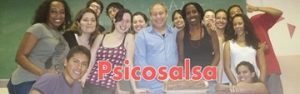
Psicosalseros 2010
Our group – PsicoSalsa – entered the University-Wide Talent Contest – Concurso de Talentos – in 2009. USP is the largest University in South America, and at that time there were over 50,000 students. So the Concurso had a huge number of “acts” in many categories: musical performances, comedy, magic, and dance (and more!). There were many competing groups in the Dance category: Belly-Dancing, Swing, Ballroom, Some Ethnic-Indio-Centered Dances from the Northeast of Brasil, Capoeira, traditional Samba as done in Brasil’s famous yearly Carnaval, Samba Gafiera (which look very much like Tango and is equally complex and demanding)…and then there was Rueda de Casino, us! PsicoSalsa won 1st Place, even winning over the groups dancing Brasilian Samba and other Brasilian dance forms!
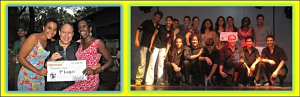
LEFT: Aline, Russ & Yordanka holding our 1st-Place Certificate and prize money (R$300). RIGHT: PsicoSalseros onstage after receiving our Trophy and Award Certificate. 2009.
During my nearly 7 years in Brasil at USP, in parallel with my research and Graduate Classes in Sensation & Perception, Retinal Function, I taught 3 classes/week of Rueda until my departure in late 2013 when I returned to the USA. Here is a grainy, brief video of one of our winning Ruedas performed in the Concurso de Talentos: https://youtu.be/5M4NdUlhtq0?si=asaQwENPRSoM-OB9 (I’m the “old” handsome dude calling out the moves for the dancers).
A “Radio-Career” Is Born: The COVID-19 Pandemic and “Afro-Cuban Latin Jazz”
Shortly after the COVID-19 pandemic hit us in early 2020, I received a somewhat desperate plea from mid-east radio station, WETF (based in Southbend, Indiana, home of Pete Buttigieg). The plea was for music…music…music. My friend and colleague and world-renowned Jazz Historian, Mark C. Gridley had received a call from the Jazz-Oriented station manager begging for weekly submissions of music to aire because they had just lost all their live DJs. And Mark agreed and then asked them if they would be interested in airing Afro-Cuban Jazz. They were! And thus I began compiling weekly 58-minute shows of Afro-Cuban Latin Jazz. Each week I selected a set of 7-10 great pieces of music to fill the 58-min slot including my Intro’s and Outro’s for each piece.
My weekly show, Afro-Cuban Latin Jazz, was, and is (I just aired the 210th weekly show), one of the most extensive and eclectic shows airing on the radio, and broadcast worldwide streaming on the internet at jazzradiowetf.org. The show features music from the African Diaspora. Yes, lots of music from Cuba, jazz as well as jazz-influenced TIMBA or other genres like Charanga. Astonishing music from groups like Chucho Valdes’ IRAKERE. Virtuoso-pianists like Chucho Valdes himself, Gabriel Hernandez, Gonzalo Rubalcaba, Charlie Palmieri, Lili Martinez, Axel Tosca, Ariacne Trujillo, Kemuel Roig, Hilton Ruiz, Jesus Molina, Martin Bejerano. The show also features music from Brazil (lots of music from Brazil, like guitarist Chico Pinheiro, Joao Bosco, Trio Zimbo, Diego Garbin, Sandro Haick, Michael Pipoquinha, Batanga e CIA, Alessandro Penezzi, Hamilton de Holanda…), from Peru (e.g. Gabriel Alegria), from Chile (e.g. trumpet player Cristian Cuturuffo), from many parts of the USA featuring amazing groups (Miami, San Francisco, New York…), from Europe (e.g., Calle Real and Soneros All-Stars from Sweden), and music from Africa that reflects a “reverse Diaspora”, where music from Cuban tradition has blossomed in Africa, absorbing a distinct flavor that blends African and Cuban approaches to the music. Examples: Africando (Senegal), Laba Sosseh (Cote d’Ivoire), Orquesta Baobab (Senegal), Ricardo Lemvo y Makina Loca (DR Congo), Gnonnas Pedro (Lokossa/Benin), Tabu Ley Rochereau (DR Congo), and many more.
[The current streaming schedule is (all in EST): Sat (7-8pm=19:00-20:00), with two repeats/week, one at 9am (9:00) Monday and a second at 1pm (13:00) on Wednesday.]