What Art Tells Us About The Brain
The Surreal Paintings of Rene Magritte
By Russell D. Hamer, Ph.D.
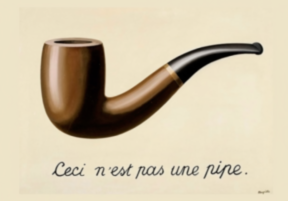
Magritte’s “The Treachery of Images” (1929): This Is Not a Pipe
“The function of painting to make poetry visible…to render thought visible.”
(René Magritte, Belgian Surreal Artist, Self-Proclaimed Philosopher)
“…visual art obeys the laws of the visual brain and thus reveals these laws to us.”
(Semir Zeki, British Neuroscientist)
<><><>
“Beauty is in the eye of the beholder” is a familiar aphorism that is true, in a poetic, metaphorical sense, but false and superficial in its literal assertion: we see with the brain, not the eye, a fact first proposed by the Iraqi scientist, Hasan Ibn al-Haytham around the year 1000 AD. The true wonders of perception emerge the more we know about how effortlessly, rapidly, unconsciously the visual system in the brain solves seemingly intractable problems in order to yield the rich experience of vision: for example, the rapid, automatic calculation of the 3rd dimension – depth and distances of objects – from a 2D array of light and dark images on the 2D retina; identification of, and segregation of objects encountered in innumerable, unpredictable spatial and lighting contexts as we move through our environment. In some sense, these are 1st-order, low-level challenges – the basics of perception: what about more complex aspects of perception? what is the perceptual basis of beauty? What elements of our perceptual-cognitive-emotional abilities are enlisted in the making of Art and the experiences it evokes?
<><><>
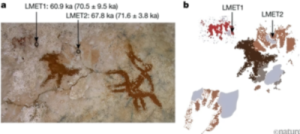
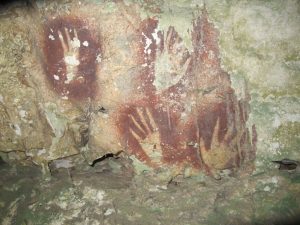
Recent findings (2026) in the caves of Muna Island, Indonesia have pushed back the date of the earlest known cave art believed to have been made by Homo sapiens to 67,800 – 71,400 years ago, the oldest securely dated cave art ever found anywhere in the world. Below on the left you see images of narrowed-finger hand stencils made by humans on the walls of Muna Island caves in Liang Metanduno, Indonesia (Octaviana et al., Nature, January, 2026). “The tip of one finger appears to have been artificially narrowed, either through the additional application of pigment or by moving the hand during pigment application, a distinct type of hand stencil art thus far identified only in Sulawesi.” (Oktaviana et al., 2026). The anthropologists conjecture that altering images of the hands in this manner may have had a symbolic meaning, possibly relating early humans’ understanding of human-animal relations.
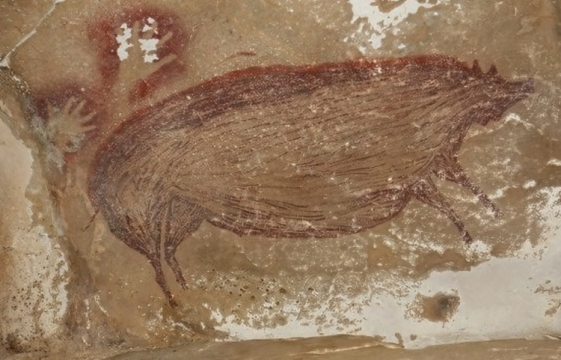
The images on the right below were found in a cave in Leang Jarie, Maros, Sulawesi (https://leakeyfoundation.org/humanitys-oldest-known-cave-art-has-been-discovered-in-sulawesi/).
[insert oldest image at the x below]
Prior to the discovery of the cave images shown above, the erliest know huam pictorial art dated back at least 50,000 years, as evidenced by other cave paintings in Sulawesi, Indonesia, in the Altamira caves in Spain (36,000 years), the Serra de Capivara caves in Brazil (25,00 years) as well as ancient art in many other locations.
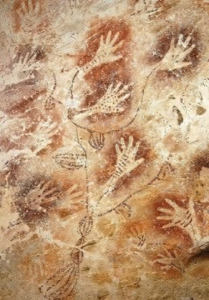
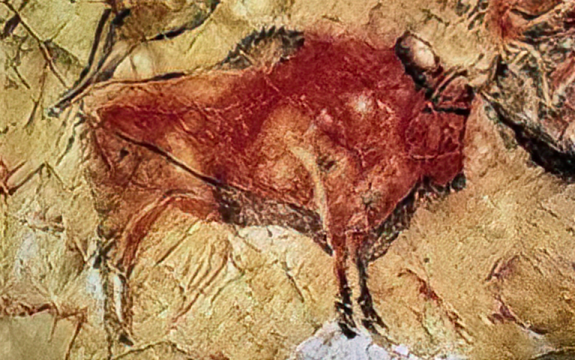
LEFT & CENTER: Cave art, Sulawesi, Indonesia, 40,000 to 45,000 years old. RIGHT: Altamira Cave painting, Cantabria, Spain, 36,000 years old
In creating such images, our ancestor-artists were performing, in effect, perceptual experiments exploring the rather abstract process of how best to convey rich, complex 3D scenes on a 2D cave wall. For this reason, many visual neuroscientists consider this 50-millennium record of pictorial expression as a bona fide kind of ancestral ‘brain science’.
<><><>
With this perspective in mind, we can begin to understand how the Surreal images painted by René Magritte in the 20th century could reveal to us some of the ‘magic’ of our own perception, sometimes even drawing our attention to our own visual brain’s powerful, automatic drive to construct robust 3D scenes in our head. Magritte succeeds at this by designing images that violate our brain’s expectations, subverting our visual system’s normal everyday understanding of scenes in which objects are familiar, and are effortlessly sorted into figure and background and organized into a robustly perceived 3D scene.
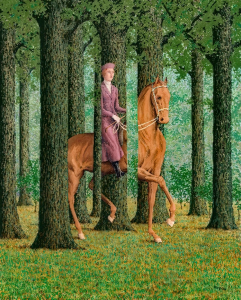
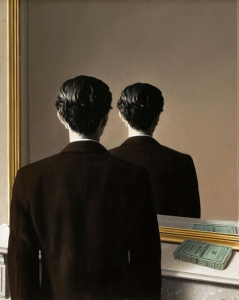
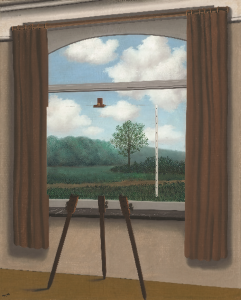
LEFT: Le Blanc-Seing (1965). CENTER: Reproduction Interdite (1937). RIGHT: La Condition Humaine (1933)
Thus, a Safari through the paintings of the Belgian Surreal Artist, René Magritte can reveal your own visual brain in action: his enigmatic designs cause figures to suddenly be seen as background, only to reverse places in the next glance; transparency battles with opacity; objects are distorted, not by the hand of the artist, but by your own brain’s drive to “make sense out of a scene”.
How do daubs of paint on a 2-dimensional canvas, which project to the back of your eye as a 2-dimensional image of light, dark and color, create a rich 3-dimensional scene in our heads? Magritte’s surreal art beckons us to ponder the difference between image and reality, always drawing us into a deeper philosophical appreciation of what we see in Art and in our daily environment. Magritte would want his Art to engage our appreciation of what he called “The Mystery of the Ordinary”.